Design is Not Dead - But the Narrative Might Be

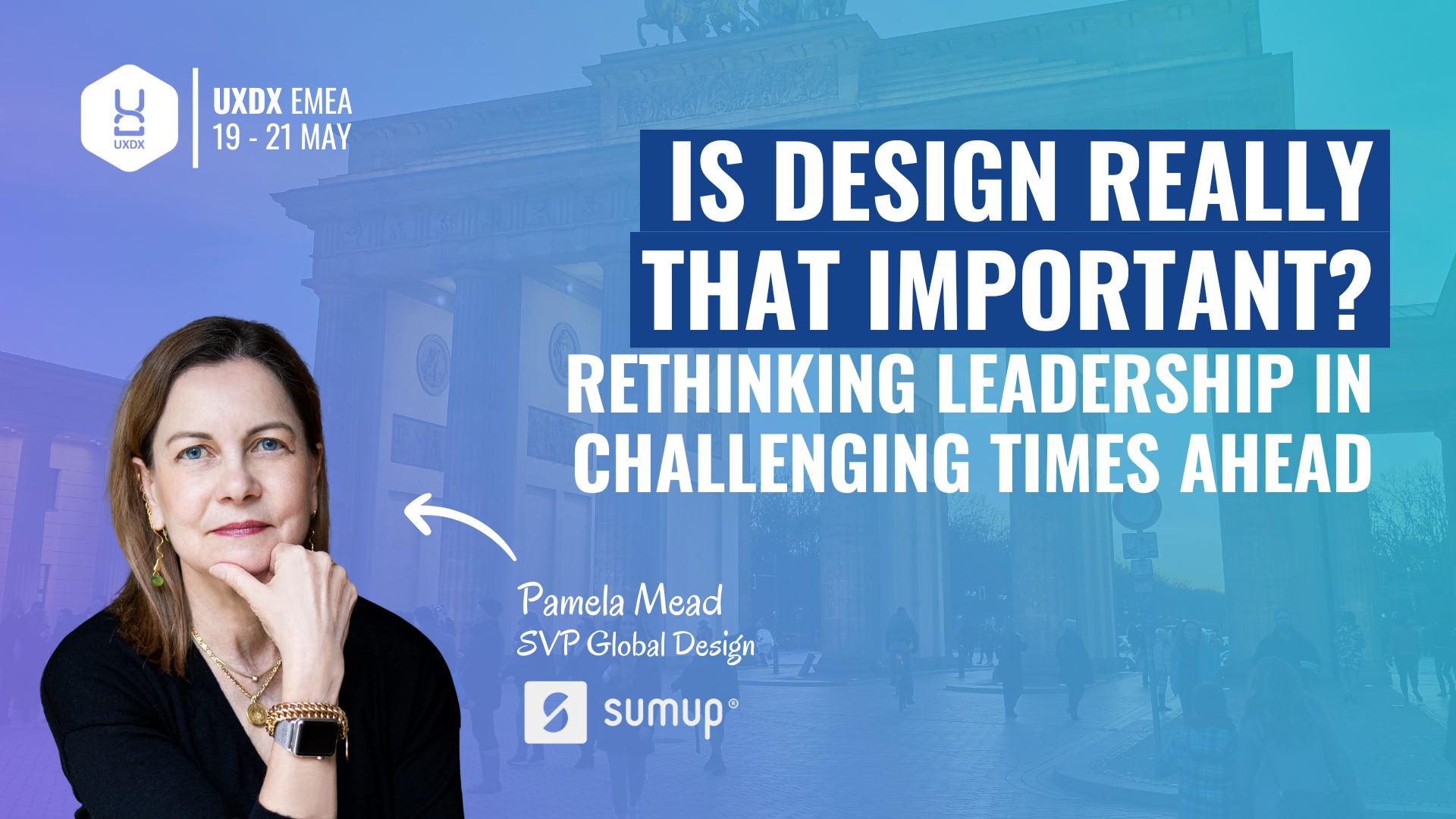
The question is not whether design still matters. It is whether the story we tell about design has started to work against us.
Berlin, Boom Cycles, and the Same Old Questions
Pamela opens with warmth for UXDX being in Berlin, then goes straight into the state of the industry. She has lived through enough cycles to recognize the rhythm. A surge of enthusiasm. A hiring boom. Then the crash. Then the soul searching.
And the soul searching always sounds familiar. Why are we still misunderstood? Why are we undervalued? Why do we still fight for a seat at the table?
Her point is not that these questions are wrong. It is that asking them again, in the same way, will keep producing the same outcomes. Instead, she wants to change the narratives designers bring into the next cycle, because the next cycle will come whether we feel ready or not.
Where We Are in the Cycle
Pamela sketches the current landscape in practical terms. Most tech companies did fine during the COVID boom, then got swept into the 2022 hiring frenzy when money was cheap, particularly in the United States. Then came the crash.
She references the flatline many people have felt in their job searches. Since around 2023, tech job openings have stayed pretty flat. Layoffs are slowing, but the market is still saturated. There are simply more people looking than there are roles available.
Then she adds a detail that stings because it matches lived experience. An analysis of layoffs across dozens of companies found that product designers and product managers are significantly more likely to be laid off than engineers. Research is hit even harder.
Pamela does not linger on the numbers to scare the room. She uses them to make a different point. If your function is seen as optional in the hard moments, you cannot solve that with better portfolio presentations. You solve it by changing what the organization believes your work actually is.
AI Enters the Story, Whether We Like It or Not
Pamela is honest about the new ingredient in this downturn. AI.
Almost 80 percent of companies are now investing in AI. Many of the early wins are predictable, like customer support automation, risk and fraud, and operational efficiency. But the use case she highlights for product development is content creation, including translation for some organizations.
In Pamela’s world, expectations are already being set that content creation could be fully automated within a year. She has opinions about that, but her bigger point is more strategic than argumentative.
If AI changes how content is produced, it changes the product development cycle. Every discipline will have to evolve how it works. Design is not the only function that will be reshaped. But design is the function currently trapped in the most fragile narrative, and that makes it vulnerable.
History is Repeating, Quietly and Regularly
Pamela steps back and gives the room a longer view. Boom and bust cycles are not rare. They are recurring. Since 1850, there have been dozens of these cycles. They tend to last seven to ten years, sometimes shorter, like the one we just lived through.
The booms tend to be triggered by innovation or regulation. Financial shifts. New platforms. New distribution. The dot com era. The post 2009 rebound. The long stretch of growth driven by mobile, cloud, and digitization.
Then the bust comes, not because the innovation disappears, but because enthusiasm gets ahead of reality.
This is where Pamela’s tone becomes quietly optimistic. If these cycles are predictable, then the goal is not to avoid them. The goal is to build a career and a discipline that can ride them without losing its identity every time the market tightens.
How Design Evolved, and How We Got Cornered
Pamela traces the evolution of design roles in tech. Graphic design moved to interaction design. Interaction grew into experience and service design. The dot-com explosion multiplied titles and specializations. Then, more recently, it all compressed again into the modern product designer.
At the same time, product development processes kept evolving too. Agile and its derivatives. Design thinking as a bridge to business. Lean startup. Design sprints. Scaling frameworks. Endless attempts to make delivery faster and more predictable.
And somewhere in that acceleration, Pamela argues, design commoditized itself.
The modern model often puts one designer inside a “pizza team” working in two-week sprints. That designer is expected to cover UI, UX, motion, design systems, pixel perfection, sometimes even code, while also working ahead for the next sprint, supporting the current sprint, and QA’ing what just shipped.
Pamela calls it insane. Not as a dramatic flourish, but as a diagnosis. The workload pushes designers toward what can be produced quickly and defended easily. The UI layer. The surface. The happy path. The MVP.
Tools like design systems and Figma make speed possible, but speed can also become a trap. When design is constantly squeezed, it regresses into decoration. And once design is framed as decoration, it becomes easier for organizations to imagine that AI can replace it.
That is not a technology problem. It is a story problem.
Narrative One, Stop Selling “Polish” and Start Reclaiming Problem Solving
Pamela’s first narrative shift is blunt. Design cannot keep presenting itself as the UI layer.
She calls design a discipline with deep scientific foundations, even if designers do not always name them. When designers build solutions that work, they draw from psychology and flow. From linguistics and semiotics to shape meaning. From information architecture to support attention in real-world contexts. From learning theory and behavioral principles to help users recover when they get stuck.
Her point is not that design needs to become academic. Her point is that design needs to be explicit about why decisions are made.
She quotes a line she credits to Erika Hall: design is choices, not artifacts. If you reduce your work to the artifact, you invite replacement. If you articulate the decisions, you communicate value.
Then Pamela zooms in on a phrase she cannot stand, because it quietly destroys credibility. Designers describe their work as playing around.
She has heard it from thoughtful designers. She has heard it at major conferences. And she stops people when she hears it, because she knows what executives hear. They hear something simplistic and repeatable. They hear something that a machine can do faster.
Pamela’s provocation is not “stop being playful.” It is “stop framing rigor as play.” When you say you are playing around, you are helping commoditize your own discipline.
Narrative Two, Stop Being the Misunderstood Hero
Pamela’s second narrative shift targets a comforting identity many designers hold, often without realizing it. The misunderstood hero.
The story goes like this. Designers are the only true user advocates. Designers are the only ones who care. Designers are the only ones who see the real problem.
Pamela pushes back. Many decisions impact users, and many of those decisions are not owned by design. Pricing. Support models. Automation choices. Business policies. These are user experience decisions too, whether they sit in a design org chart or not.
She also challenges the phrase “good design.” Good for whom? Good for the user in one moment might be bad for the business model. Good for the business might not require good design at all. Those tensions exist, and pretending they do not exist is part of why design gets stuck arguing for purity rather than building influence.
Pamela shares an anecdote from Telefonica that captures a common leadership blind spot. In trying to bridge an internal divide, she kept offering “design can help” as the answer. A VP finally said, half-amused and half serious, “It sounds like design has the answers for everything.”
Pamela admits she felt that way. Many designers do.
But the correction is not to shrink the design’s ambition. The correction is to shift from hero to collaborator. The problems companies face are solved by the room, not by one function. The designer’s leverage comes from lateral leadership, storytelling, and communication that brings others into a shared understanding of value.
At SumUp, she notes, the written word matters. Writing forces clarity. Communication becomes part of the craft, not an afterthought.
She returns again to Erika Hall with another sharp reminder. Design can only be as user-centered as the business model allows. So the move is not to cling to “user-centered” as an identity. It is to become value-centered, and then connect value back to users in a way that the business can sustain.
Narrative Three: AI Is Not a Winner-Takes-All Game
Pamela does not deny the anxiety. Content is under pressure. Engineering is being accelerated by AI tooling. Designers see engineers experimenting with interface generation and wonder what happens next.
Her response is not denial, and it is not fear. It is discernment.
Design has strengths that matter in an AI-shaped workflow. Judgment. Decision making grounded in human behavior. The ability to frame problems. The ability to evaluate tradeoffs. The ability to steer, not just produce.
But Pamela also refuses the fantasy that one function will “win” AI. This is not a winner-takes-all game. It will be about how disciplines collaborate, how they adopt tools, and how they rethink the system of product development together.
If the next boom is driven by AI, then the teams that thrive will be the teams that treat AI as a shared capability, not a design threat and not an engineering toy.
Want to watch the full talk?
You can find it here on UXDX: https://uxdx.com/session/design-is-not-dead-but-the-narrative-might-be/
Or explore all the insights in the UXDX EMEA 2025 Post Show Report: https://uxdx.com/post-show-report

Rory Madden
FounderUXDX
I hate "It depends"! Organisations are complex but I believe that if you resort to it depends it means that you haven't explained it properly or you don't understand it. Having run UXDX for over 6 years I am using the knowledge from hundreds of case studies to create the UXDX model - an opinionated, principle-driven model that will help organisations change their ways of working without "It depends".
Get latest articles straight to your inbox
A weekly list of the latest news across Product, UX, Design and Dev.