From Design Systems to Interaction Systems: Creating Coherent AI Experiences

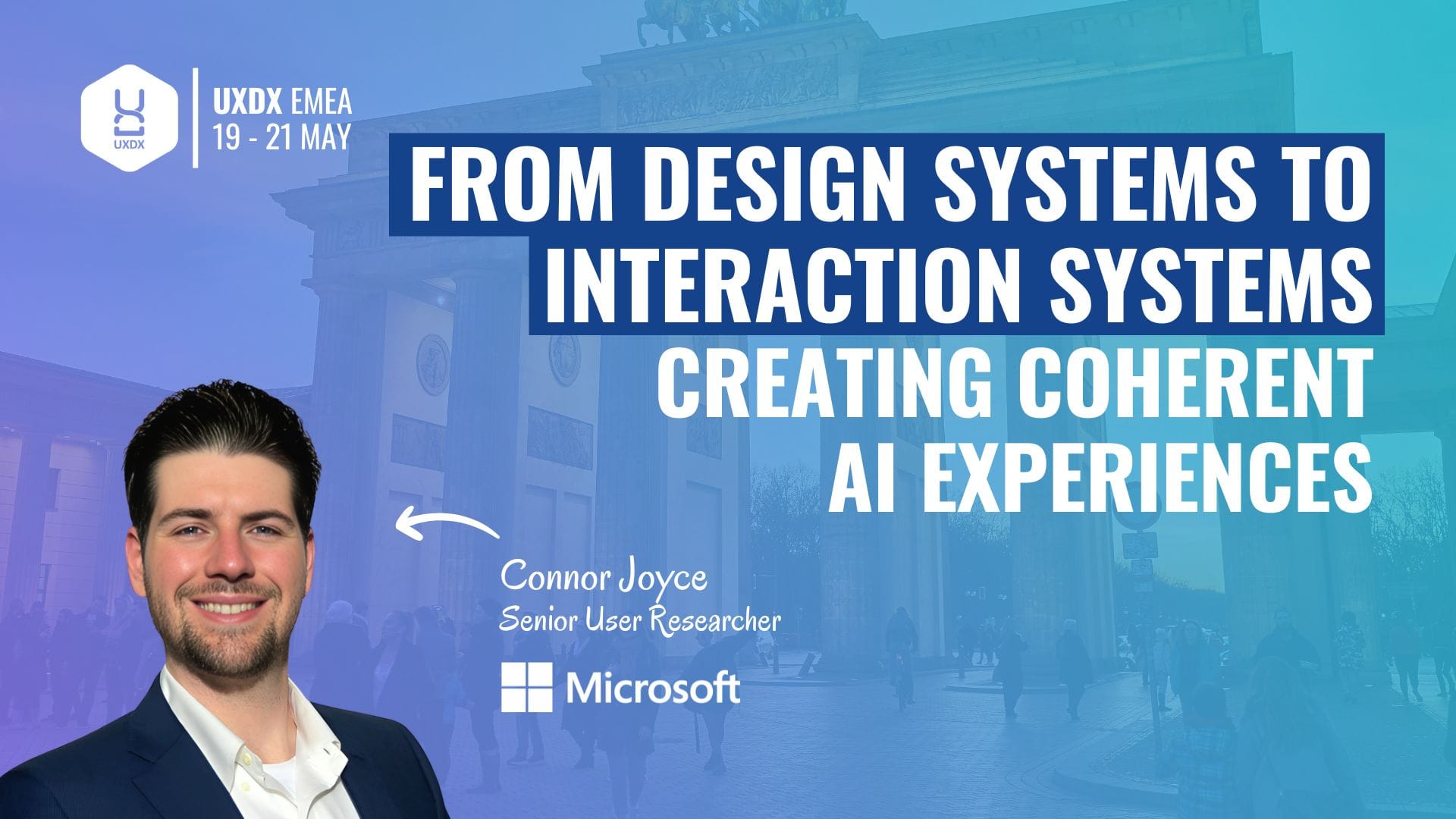
How Connor Joyce Sees AI Transforming Product Coherence
In a year defined by rapid AI adoption, Connor (Senior User Researcher at Microsoft) delivered a talk at UXDX EMEA 2025 that cut through the hype with a clear call for discipline. Rather than pushing teams to ship more AI features, he urged them to pause and reconsider how AI should behave, how it should be integrated, and how teams can build products that feel unified instead of fragmented. His central argument was that design systems must evolve. The visual component libraries that have supported product teams for more than a decade are no longer enough. In the age of AI, systems need to guide behaviour as much as interface. They need to grow into interaction systems.
A Career Built on Systems-Level Thinking
Connor’s journey toward this realisation began long before Copilot or generative AI dominated conversations. His early work at Microsoft focused on Workplace Analytics, where he helped build frameworks that turned organisational data into insights. When that work evolved into Microsoft Viva, he left to write his book, Bridging Intention to Impact, consult with startups, and explore how AI could be deployed responsibly across full product suites. He later joined BetterUp, where he worked on the rollout of AI features across an entire ecosystem. Those experiences shaped his understanding of AI not as a single product but as a network of interconnected behaviours. When he returned to Microsoft as the company accelerated its Copilot strategy, he saw that the challenge was no longer simply building AI. It was creating coherence across dozens of teams that were each building their own version of intelligence.
The Moment in Kathmandu
Connor anchored his talk with a story from his travels. After weeks on the road across Asia, Europe, and the US, he found himself on the back of a motorcycle in Kathmandu, waiting in the middle of what looked like pure chaos. Motorbikes wove around cars, tuk tuks bypassed pedestrians, and vehicles flowed without lanes, signals, or visible order. Yet everyone understood how to move. It reminded him of Chicago, where explicit rules painted lanes, traffic lights, and signage govern every decision. Despite their differences, both systems produce similar outcomes because both rely on shared rules, whether implicit or explicit. For Connor, this was the perfect metaphor for AI. Today’s AI features operate more like Kathmandu. They emerge quickly, guided by intuition, urgency, and local decision-making. What is missing is the Chicago version: a shared, explicit set of rules that define how AI should behave across an organisation.
Why Visual Design Systems Fall Short
This metaphor led Connor to the heart of his argument. Traditional design systems were built to standardise the visual layer of products. They control colours, spacing, component libraries, and interaction patterns at the interface level. That work remains valuable, but AI introduces a different category of complexity. AI systems are conversational, adaptive, and stateful. They respond to latency, ask questions, offer suggestions, and move information between surfaces. These are behavioural concerns, not visual ones. Connor explained that teams often decide these behaviours in the moment, under deadline pressure. A designer, PM, or engineer chooses how the model confirms a request, how long it waits before responding, or how it handles errors. Another team solving a similar problem elsewhere in the organisation makes a different choice. Over time, these small inconsistencies accumulate, creating a product suite that feels disjointed. Visual coherence does not guarantee behavioural coherence.
Why Interaction Systems Matter
The distinction Connor drew between AI-enhanced features and conversational AI helped illustrate the need for a more holistic system. AI-enhanced features are focused and predictable. A single button triggers a summarisation, draft, or recommendation. They work because they remove complexity. Conversational AI, by contrast, offers flexibility but can overwhelm users who are uncertain about what to ask or how to phrase their intent. Both patterns are valid, but the choice between them is rarely straightforward. Teams often choose based on personal preference or engineering availability rather than a shared strategy. An interaction system answers this by defining behavioural principles, expectations, and patterns that help teams make coherent decisions. It shifts the system from a library to a compass.
Rewiring Fluent from the Inside
To begin creating this compass at Microsoft, Connor organised a workshop with the Fluent design system team. The first part focused on understanding the emotional reality of this moment. Many design system teams feel overwhelmed by the pace of AI and uncertain about their role in shaping behaviour rather than visuals. The second part was more analytical. Connor gathered challenges from stakeholders across Microsoft and from peers at companies like Google and Salesforce. These conversations exposed recurring behavioural gaps: how to handle cross-surface handoffs, how to communicate latency, how much prompting a system should provide, and how to maintain consistency when dozens of teams ship AI features simultaneously. The Fluent team used this to reorganise its structure. Dedicated groups emerged around conversational AI, AI-enhanced features, and behavioural design language. This reorganisation reflected a shift from supporting teams to guiding them.
Leading Through Guidance, Not Control
Connor emphasised that leadership for systems teams does not come from gatekeeping or policing. It comes from creating clarity. Fluent began producing research briefs that articulated behavioural expectations in plain language, helping teams understand not only what to build but why. They created Figma starters designed with AI patterns in mind, giving designers a starting point that reflected the new behavioural guidelines. They documented engineering patterns that connected behaviour to implementation and ensured that guidance survived beyond the design phase. One of the most powerful tools turned out to be shared discussion threads. Dozens of designers, engineers, and PMs across Microsoft participate in collaborative threads around topics like latency and handoffs. These threads nurture alignment, surface contradictions, and accelerate knowledge sharing.
A Defining Moment in a Handoff Meeting
Connor recalled a moment that captured the impact of this shift. In a meeting about cross-application handoffs, multiple teams described their own plans for moving AI-generated content from chat into Outlook, Word, or other surfaces. Each team had a slightly different approach. When he asked who was responsible for thinking about the experience holistically, a product manager replied: the design system team. For Connor, this was the confirmation that Fluent was becoming what he believed design systems must become: leaders of coherence, not libraries of components.
The Future of Coherent AI
As he closed his talk, Connor encouraged teams to look inward. The recurring challenges that appear across AI projects are not isolated frustrations. They are signs that a system is needed. They reveal where behaviour needs guidance, where patterns are missing, and where decisions have become too dependent on intuition. For Connor, the companies that will deliver truly coherent AI are the ones that build interaction systems—systems that shape how AI behaves, speaks, responds, and supports users across every part of the product. The future of AI will not be defined by the number of features launched but by how unified they feel. Interaction systems are how organisations move from chaos to clarity, from speed to intentionality, and from scattered intelligence to a coherent whole.
Want to watch the full talk?
You can find it here on UXDX: https://uxdx.com/session/from-design-systems-to-interaction-systems-creating-coherent-ai-experiences/?utm_source=LinkedIn&utm_medium=Blog&utm_campaign=full+talk
Or explore all the insights in the UXDX USA 2025 Post Show Report: https://uxdx.com/post-show-report/?utm_source=LinkedIn&utm_medium=Snippet&utm_campaign=Post+Show+Report

Rory Madden
FounderUXDX
I hate "It depends"! Organisations are complex but I believe that if you resort to it depends it means that you haven't explained it properly or you don't understand it. Having run UXDX for over 6 years I am using the knowledge from hundreds of case studies to create the UXDX model - an opinionated, principle-driven model that will help organisations change their ways of working without "It depends".
Get latest articles straight to your inbox
A weekly list of the latest news across Product, UX, Design and Dev.