Mihaela Draghici
Mihaela Draghici — Ambassador at UXDX. Talks and sessions delivered at UXDX.

Ambassador

Mihaela Drăghici is a product leader with 15 years of experience building global B2B and B2C products across industries including education, e-commerce, affiliate marketing, and automotive.
She has led cross-functional product teams and launched digital products, working closely with engineering, design, business, and executive stakeholders in complex organisations.
In these environments, she observed a recurring pattern: product teams rarely fail because of strategy or talent. They fail because people across functions interpret the work differently.
She challenges a common assumption: that alignment is a process problem. In reality, it’s a language problem.
Drawing on her education in linguistics and her experience leading cross-functional product teams, she focuses on making this invisible layer visible: surfacing assumptions, aligning meaning, and building the shared language that enables teams to move faster and make better product decisions.
Past talks
11 talks · 6 events
When AI Knows Too Much: Personalisation That Builds Trust Vs Breaks It
AI is changing the scale of personalisation. Products can now infer needs, predict behaviour, recommend the next action and sometimes pre-empt what a customer may want before they have asked for it. But the same capability that feels helpful in one moment can feel intrusive in another. In this session moderated by Mihaela Draghici, Pallavi Modi and Sam Bradley explore the leadership judgement required to make AI-driven personalisation feel like a service, not surveillance. The discussion moves beyond how much data a company can collect, and focuses instead on how products behave with the data they have. When does relevance build trust? When does it cross the line into manipulation? How should teams think about context, timing, consent, explanation and data provenance, especially when customer money, identity or long-term brand trust are involved? Together, Pallavi and Sam will unpack where personalisation genuinely helps customers, where teams should deliberately hold back, and what product leaders should ask before scaling AI-enabled experiences.


The Unblocker Awards
This year in Berlin, we will be announcing the winners of The Unblockers, three awards built to recognise cross functional teams who can show a clear chain from evidence to decision to impact. This is not a popularity contest, and it is not about glossy decks or “best process” theatre. It is about practical case studies that other teams can learn from, grounded in what actually changed and what it moved. Award categories - Impact Award: Evidence that led to real outcomes (adoption, retention, conversion) - Best Use of AI Award: AI that changed how you work or what you built - The Unblocker Award: Removing barriers so cross functional teams move faster Winners will be announced live in the final session.

Your Language Blueprint Is Breaking Delivery: How to fix the words that create rework, delays, and “alignment” meetings
Leadership and product teams often use the same words but mean different things. That language gap turns into rework, delayed decisions, and endless “alignment” meetings. In this 3 hour hands-on workshop, Mihaela Draghici helps you identify the high-frequency terms that quietly slow down execution, then fix them with a practical language mapping method you can reuse within your teams. What you will learn: - How identical terms fracture across disciplines, seniority levels and domains, even in experienced teams - A repeatable facilitation method to surface and resolve meaning gaps quickly - How to translate shared language into clearer decisions, fewer re-alignment loops and smoother delivery What you will take away: - A Language Map showing which terms in your team need translation and alignment - A glossary of agreed, shared definitions for critical terms - A reusable framework you can run with your own teams whenever alignment starts slipping
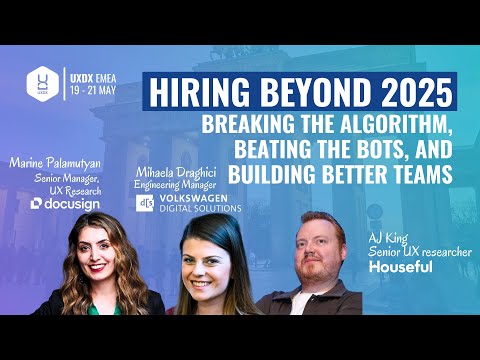
Hiring Beyond 2025: Breaking the Algorithm, Beating the Bots, and Building Better Teams
Hiring today is broken. Candidates are getting filtered out by AI before a human even sees their application, and hiring managers are often relying on outdated methods that don’t assess the full potential of a candidate. This discussion will tackle hiring challenges from both sides of the table: \- How candidates can stand out despite AI screening and generic recruitment pipelines. - Why skills, mindset, and cultural fit matter more than portfolios or take-home assignments, and how hiring managers can assess them effectively. - How hiring managers can better brief recruiters to identify the right talent, even if they aren’t design or product experts. - How teams are using AI and hiring tech effectively without missing top candidates or introducing bias. - Real-world hiring strategies to improve hiring outcomes for both job seekers and hiring managers.


From Cross-Functional to Cross-Purposes: Why Collaboration Falls Apart Over Time
Cross-functional collaboration is widely regarded as essential for effective product development. You’ve built cross-functional teams. You’ve broken down silos. You’ve aligned product, business, and engineering more. Yet, collaboration can still feel challenging at times. In this talk, Mihaela shares reflections on the experience of embedding business stakeholders into hybrid product teams, and the unexpected ways that teams often find themselves gradually drifting back into misalignment and silos—even after setting up strong collaboration frameworks. The culprit? A mix of hidden structural forces, team habits, and, most critically, language misalignment. When teams unknowingly speak different “languages”—not just across industries but across functions—communication breaks down, expectations become misaligned, and collaboration suffers. Drawing from real-world examples, Mihaela explores common patterns that cause well-intentioned collaboration to falter over time and teams to revert to silos. Mihaela will share lessons learned and practical strategies to prevent these failures, from identifying linguistic mismatches early, to maintaining long-term alignment across business, product, and engineering teams. If your teams are struggling to stay aligned despite their best efforts, this talk will show you why—and how to support collaboration more effectively over the long term.
Influencing Organisational Culture
Culture eats strategy for breakfast! But what exactly is a company's culture, how does it influence how you get things done and how do you go about influencing the company culture to enable better product development? Join this forum to discuss different culture types and the techniques that people use to influence change.
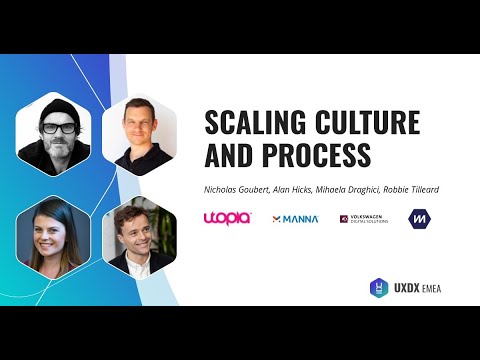
How High-Growth Tech Companies Scale Culture & Process
There are a number of ways technology companies scale fast. Scaleups that acquire other companies achieve their goals faster than those who grow organically, however they have mammoth culture, team and product integration complexities. Those who have grown organically, that culture and process that helped define their launch can be one of the hardest things to scale. Leaders of these companies are under pressure to determine which elements are worth preserving, how they align with the forward-looking business strategy, and how to define and foster that's ideal as the organization expands and integrates new people into the ranks. - Integration of acquisition: How you bring that into your portfolio - How do you manage that coupled with organic growth - Balancing short and long-term vision





Bridging the Gap to Ensure Business Alignment Between Product and Dev
Shifting from a requirements approach to an outcomes approach is a difficult task. Equally how do you get developers to own the experience? The role of a product manager isn’t to dictate the requirements but often the product manager is the person to decide. How do you encourage developers to take more ownership of the outcomes and not wait for requirements? How can developers be more involved in discovery and shaping the product? Moderated by Sudev Balakrishnan, CPO for Stash, join the conversation, share your insights and probe the speakers on the elements of their talks that left you wanting more.


What Language Do You Speak?
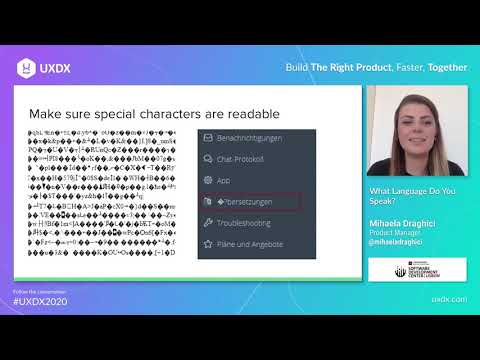
As Product Managers, we need to ensure we're building great products to satisfy a user need or solve a problem. For this, we need to understand our users and stakeholders, make sense of data, understand tech and business implications, communicate and translate information across different teams. We need to speak the ‘right language’ in order to be successful PMs. But what does it mean? On one hand, through working on global products and platforms, as part of multicultural teams, I learned I was at an advantage for being multilingual. I was able to understand our users and align with them, be the voice of our users towards my teams and stakeholders, and ensure our products were of quality across different regions. On the other hand, as PMs, we’re the connectors between different people and roles: users, designers, senior management, engineers, data scientists and they each communicate differently. My talk covers contexts in which PMs need to speak different languages, with practical examples, spiced with a few 'no-nos' and suggestions on how to adapt our language depending on the groups we’re interacting with. We’ll understand what 'speaking the right language' means for a PM and that it can be a 'make or break' our products.