How Pinterest Builds Visual Experiences That Connect

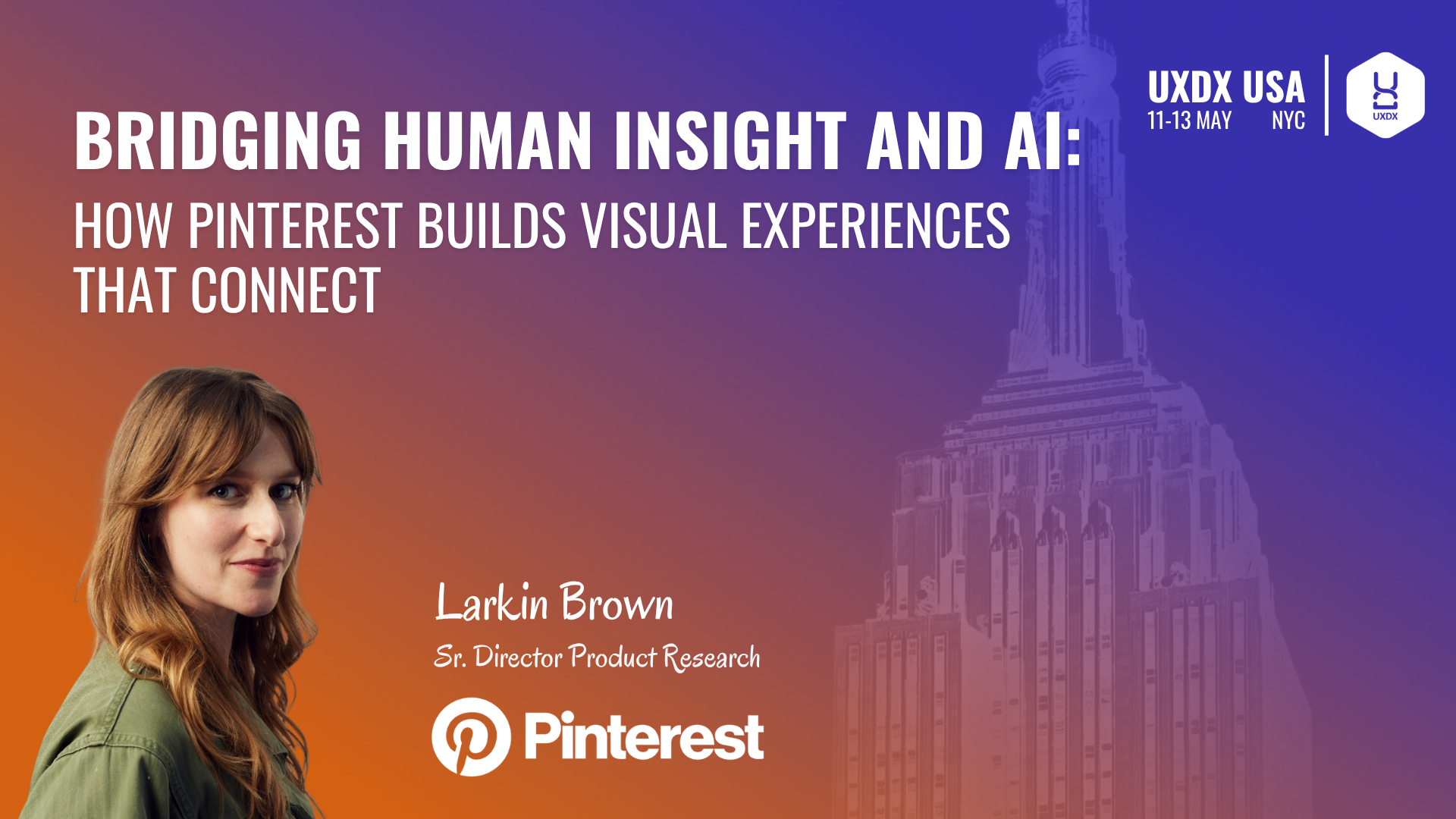
AI can generate endless answers, but inspiration is not the same as connection. In her talk at UXDX, Larkin Brown, Sr. Director Product Research at Pinterest, showed how years of human-centred research are being woven into AI-powered product experiences. Her message was clear: the future of visual discovery will not be built by AI alone, but by combining machine intelligence with the messy, subtle and deeply human ways people search for who they want to become.
When people do not have the words yet
Larkin Brown opened her talk not with a dashboard, a model or a metric, but with a personal stylist.
She described walking through a department store, watching a stylist pull clothes from the racks while trying to understand what her client actually wanted. The client had said she wanted to look “put together”, which the stylist quickly dismissed as almost meaningless because everyone says it. Then the client said she wanted “a little bit of edge”. But edge means different things to different people.
So the stylist started showing images. Black? No. Leather? No. Eventually, the answer emerged: the client liked hardware details.
That small moment captures something Pinterest has understood for a long time. People often do not know exactly what they are looking for until they see it. Language is imprecise, especially when the goal is aesthetic, emotional or aspirational. A person may not be able to describe their style, their dream room, their wedding flowers or the feeling they want from an outfit. But they can react. They can save, reject, refine and follow a visual thread until something clicks.
In 2014, Brown studied professionals whose job was to guide people through that uncertainty: personal stylists, interior decorators and wedding planners. She came back with frameworks, backbone questions and decision trees. The team even built a quiz. But at the time, the technology was not flexible enough to recreate the responsiveness of those human conversations.
A decade later, that same research has become newly valuable. With AI, Pinterest can revisit those insights and begin building product experiences that respond more fluidly to human intent.
Pinterest is built for becoming
Pinterest’s mission is to bring everyone the inspiration to create a life they love. That sounds simple, but the behaviour behind it is complex. People come to Pinterest to browse, search, save and curate ideas across many parts of their lives. The platform now has hundreds of millions of monthly active users, billions of monthly searches and billions of Pins saved every week.
What makes Pinterest especially interesting is that people are not only looking for information. They are often exploring future versions of themselves.
Brown highlighted Gen Z as a particularly important audience. More than half of Pinterest’s monthly active users are now Gen Z, and many see the platform as a place to shop. That makes sense because teenage and early adult years are full of identity formation. People are trying on styles, interests, aesthetics and ambitions. They are building a blueprint for the person they might become.
Pinterest supports that process because it is visual, exploratory and pressure-free. It is not a social network built around performance, posting or public judgement. There are no mean comments attached to a private board of ideas. Instead, users can collect, compare and explore without having to declare who they are yet.
This is where Pinterest’s strength lies. It helps people search before they have the words.
The beauty of the rabbit hole
Brown described Pinterest as a place of nonlinear discovery. A user might start with one idea and end somewhere unexpected. A vintage orange jacket leads to street style, which leads to clear sunglasses, which leads to jelly sandals, which leads to socks with sandals. The path is not linear, but it is meaningful.
This creates a product challenge. People can have multiple intents in a single session. They might begin with home renovation, get pulled into colour inspiration, then end up looking at fashion or travel. The platform cannot simply assign one intent to the session and optimise around it.
It also cannot assign one fixed meaning to a single image. A flower photo may be useful to an art student because of its shadows. Another person may save the same image as wedding inspiration. The image is the same, but the intent is different.
That complexity makes content understanding difficult, but it is also what makes Pinterest powerful. The same visual object can carry different meanings for different people. Inspiration is not only in the image. It is in the relationship between the image and the person looking at it.
A human-powered data set
Behind Pinterest’s discovery experience is what Brown called the taste graph. Pinterest understands style and aesthetics through the connections people make as they search, save and curate. Because users engage across many domains of life, Pinterest can identify unexpected links between personal style, home decor, recipes, travel destinations and more.
This makes Pinterest valuable for trend spotting, but it also gives the platform something especially important in the AI era: a deeply human data set.
The data is not just clicks. It is years of people saving dreams, preferences, aspirations and possibilities. That gives Pinterest a unique foundation for personalisation, but Brown was careful to point out that human quality is not guaranteed when new AI technologies are layered on top. It has to be deliberate.
This is one of the most important arguments in the talk. AI can make products faster and more responsive, but it can also flatten the very human nuance that makes a product meaningful. For Pinterest, the challenge is not simply to build LLM-powered features. It is to build them in a way that preserves the humanness of visual discovery.
The challenge of evaluating AI experiences
One of Pinterest’s experiments is the Pinterest Assistant, an LLM-powered experience currently in development. But evaluating whether an experience like this is “good” is not straightforward.
With traditional software, teams can often test whether a flow works, whether a user completes a task or whether a recommendation is clicked. With LLM-based experiences, the output is more fluid. The same user might ask a similar question in different ways. A multi-turn conversation might go in several valid directions. The answer may include text and images, and success may depend on taste, context and personal relevance.
Pinterest also faces specific challenges. Its users have high expectations for personalisation. The product needs to understand aesthetics, vibes and visual taste, which are difficult to operationalise. And unlike many LLM experiences, Pinterest cannot rely on text alone. The experience has to feel visually native to the platform.
This is where product research takes on a new role. Researchers are not only evaluating whether users like a feature after it is built. They are helping define what good looks like inside the system itself.
Research and machine learning, side by side
Brown described a shift in how Pinterest teams work. Instead of research handing findings to product, product handing requirements to engineering and engineering building the system, researchers and machine learning engineers are starting to work side by side. She described this as ML engineer and research pairing.
That pairing happens downstream and upstream. Downstream, researchers help evaluate LLM outputs. They design “judges”, which are prompts or systems intended to answer whether a particular output is good. But for Pinterest, that judgement is qualitative and messy. A conversation may include visual results, text, multiple turns and personal interpretation.
To make that evaluable, researchers create rubrics. This is similar to survey design: the criteria need to be clear enough that human evaluators can judge consistently, and an LLM can also be trained to evaluate the output. The team then compares human evaluators and LLM evaluations, looks at agreement and calibrates.
This is a new research skill. It requires distilling years of user understanding into structured prompts and evaluative systems that can be coded into the product.
Testing on real human queries
One of Brown’s most practical examples was about query sets. While building an early judge, the team noticed that the queries being used to test the product were synthetic. They were reasonable guesses, but they were not real.
That mattered.
A researcher pulled 1,000 real queries from Pinterest users, making sure they represented classic use cases and a range of complexity. The team then narrowed that down to 100 queries that could be used for daily evaluations.
This revealed gaps in the synthetic data. In fashion, for example, it was missing men’s fashion, wedding fashion and some Gen Z aesthetic language. If those gaps remained in the evaluation set, the model could improve against the wrong benchmark while still failing real users.
This is a vital lesson for any AI product team. If the test data is not representative of real user behaviour, the system may look better than it actually is. Evaluation is not neutral. It encodes assumptions about who matters and what success means.
Putting research directly into the prompt
Upstream, Pinterest is using years of foundational research to shape LLM experiences from the beginning.
Brown described how one principal researcher synthesised more than 60 studies, using AI to help identify themes. The output was six endemic user journeys, capturing what those journeys look like today, where the pain points are and what a happier path might look like.
In the past, this might have become a beautiful deck or long research document. Instead, the researcher created an interactive HTML file and put it on GitHub. That matters because cross-functional teams can now copy and paste parts of the research directly into the prompts and prototypes they are building.
The researcher also wrote user experience principles that can be inserted into LLM prompts. In other words, research is no longer only informing product strategy indirectly. It is being translated into material that can shape the behaviour of AI systems directly.
For researchers, that is a major shift. The work can move closer to the product itself, with fewer layers of interpretation in between.
Infinite solutions still need insight
Brown also warned about one of the risks of AI: it can generate endless solutions before the team has properly understood the problem.
She used a classic human-centred design pattern: observation, insight, opportunity, solution. An observation might point to a pain point, but the insight explains the deeper meaning behind it. The opportunity reframes what should be solved. Only then should teams generate solutions.
AI makes it extremely easy to jump from observation to infinite solutions. But without the insight and opportunity, teams may simply produce more ideas without knowing whether they matter.
This is where researchers remain critical. Their job is not only to test concepts. It is to help teams understand the deeper meaning behind what they observe, then create a shared sense of the opportunity.
Brown put it simply: shared understanding comes from shared experience.
Get in the box and out of the box
Brown ended with two pieces of advice for researchers and researcher-design hybrids.
First, get in the box. Learn how to work in the prompt box. Build the skill of translating foundational research into prompts, principles and structures that technical teams can use to shape AI products.
Second, get teams out of the box. Bring cross-functional partners into the real world through shop-alongs, in-home research, dinners with users, analogous worlds and fieldwork. AI systems are probabilistic. They are designed to predict the likely next thing. But innovation often comes from the unlikely connection, the edge case, the surprising behaviour and the moment that does not sit in the centre of the bell curve.
The future of AI-powered product development needs both.
Pinterest’s work shows that AI can make visual discovery more responsive, but only if the product remains grounded in human insight. The machine can help generate, evaluate and personalise, but the human work is still essential: understanding ambiguity, preserving nuance, finding unexpected patterns and asking what people are really trying to become.
AI may help Pinterest build better visual experiences. But human insight is what makes them connect.
Want to watch the full Talk?
You can find the full talk here: https://uxdx.com/session/bridging-human-insight-and-ai-how-pinterest-builds-visual-experiences-that-connect/
Or explore all the insights in the UXDX USA 2026 Post Show Report: https://uxdx.com/post-show-report

Rory Madden
FounderUXDX
I hate "It depends"! Organisations are complex but I believe that if you resort to it depends it means that you haven't explained it properly or you don't understand it. Having run UXDX for over 6 years I am using the knowledge from hundreds of case studies to create the UXDX model - an opinionated, principle-driven model that will help organisations change their ways of working without "It depends".
Get latest articles straight to your inbox
A weekly list of the latest news across Product, UX, Design and Dev.