Simplifying Journeys Across Exploding Channels

Simplifying Journeys Across Exploding Channels
Customers no longer begin their journey where brands expect them to. They might discover a product through ChatGPT, validate it through a creator, compare it through search, buy it in an app and pick it up in store. In her talk at UXDX USA this year, Sneha Narahalli, SVP, Head of Product & UX at Sephora explained why the next era of commerce is not about adding more channels. It's about making complexity invisible by designing around intent.
When omnichannel is no longer enough
For years, omnichannel was the defining ambition in commerce. Brands worked to connect stores with digital, web with app, online with offline. The goal was to make each touchpoint feel joined up, and for a while, that was enough. If a customer could browse online, buy in store, collect locally or continue a journey across devices, the experience felt advanced.
But the landscape has shifted again. As Sneha Narahalli explained in her UXDX talk, digital itself is now fragmenting. Customers are not entering through one predictable route. They are arriving through search, social, creators, apps, stores, AI assistants, conversations and recommendations.
That changes the shape of the customer journey. It no longer starts on a homepage or follows a neat path through a product page, basket and checkout. It starts wherever intent appears.
A customer might ask ChatGPT what skincare routine suits their needs. They might validate a product through a creator or social content. They might compare reviews through search, check availability in the app, then decide to collect from a nearby store. To the customer, this is not a collection of separate channels. It is one continuous attempt to solve a problem.
That is why Narahalli argued that commerce is moving from omnichannel to intent-driven. In her words, “Omnichannel connected the channels. Intent-driven commerce connects decisions.”
Customers do not think in channels
One of the most important points in the talk was also the simplest: customers do not think in channels. They think in needs, questions and moments:
Help me choose.
I need this today.
Will this work for me?
What’s near me?
Can I trust this?
For brands, the temptation is still to design around destinations: the homepage, the product listing page, the search results page, the app, the store or the checkout flow. These are familiar units of ownership, measurement and optimisation. But customer behaviour has become far less linear.
For brands, the temptation is still to design around destinations: the homepage, the product listing page, the app, the store or the checkout flow. These are familiar units of ownership, measurement and optimisation. But customer behaviour has become far less linear.
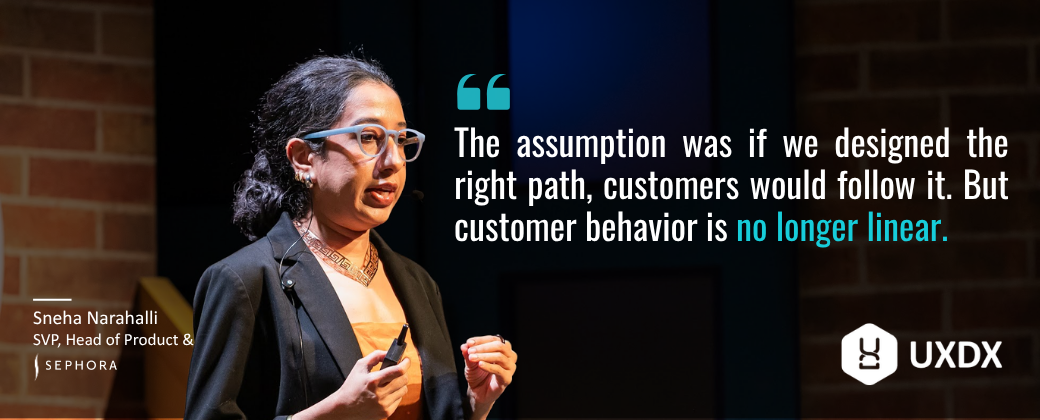
That means the destination is no longer the centre of the experience. Intent is. Instead of asking, “How do we drive customers through a flow right now?” teams need to ask, “What is the customer trying to accomplish right now? What’s the decision that they’re trying to make?”
This is a significant shift for experience design. It moves the focus away from guiding people through predefined journeys and towards responding intelligently to what they need in the moment.
The real challenge is continuity
Most large organisations already have strong channel coverage. They have apps, websites, stores, social presence, search strategies, service teams and marketing systems. The problem is not the absence of touchpoints but the continuity between them.
Every new touchpoint creates an opportunity for context to be lost. A customer may discover something through AI, research it through search, engage with social content and purchase through the app, but too often each interaction behaves as if it is the first. The system does not remember enough. The experience resets. The customer has to repeat themselves, re-enter information or rebuild confidence from scratch.
That friction is visible and makes the brand feel less intelligent, even when individual channels are performing well. Narahalli was clear about where the difficulty lies: “What surprised me the most is that technology isn’t the hardest part of it all.” The deeper challenge is fragmented ownership and fragmented context across systems. Web teams optimise the web. Store teams optimise stores. Marketing teams optimise acquisition. Support teams optimise service. Each area may be doing good work, but the seams between departments become visible in the customer experience.
Customers experience one brand. Internally, however, many organisations still behave like separate systems.
Intent needs context
Intent alone is not enough. The same phrase can mean very different things depending on the situation.
“Help me choose” means one thing late at night and another in a store, in a hurry, when replenishing a product or when looking for inspiration. The expressed intent may be the same, but the context changes the right response.
That is why decision-making now needs to happen at the intersection of channel, moment and intent. Relevance is no longer just about personalisation in the traditional sense. It is about situational understanding: recognising what the customer is trying to do, where they are, what they already know, what they need next and what constraints are shaping the moment.
In beauty, this becomes especially important because the questions can be personal and uncertain. A customer might ask which sunscreen is best for hyperpigmentation, whether a product will work for sensitive skin, whether two products can be layered, or what routine they should use. The right response depends not only on the product catalogue, but on preferences, prior behaviour, skin concerns, inventory, location and fulfilment options.
The customer should not have to navigate all of that complexity. The system should absorb it.
From static journeys to responsive systems
Narahalli described a different way of thinking about experience design: not as a sequence of steps, but as a system that continuously responds to customer intent.
That requires three capabilities. First, the system needs to understand the intent. Second, it needs to carry shared context across touchpoints. Third, it needs to make decisions in real time.
This does not mean channels stop mattering. Apps, stores, search and social are still important. But they can no longer operate as disconnected surfaces. They need to be connected through a shared orchestration layer that helps the system understand what the customer is trying to do, what is already known about them and what should happen next.
In her words, “this continuity itself becomes the product.” The customer may never see the orchestration layer, but they feel its presence when the experience makes sense, when the next step is useful and when they do not have to start again.
Checkout as a moment of confidence
One of the clearest examples from Sephora was checkout. Traditionally, checkout is treated as the final step in a transaction. But Narahalli described it differently: “Checkout is really a moment of confidence.”
By the time a customer reaches checkout, they have already made a decision. The role of the system is not to restart the experience or introduce more work. It is to preserve momentum and reduce friction.
That means carrying forward the context the system already has: basket information, device context, fulfilment preferences and payment options. Instead of forcing customers to re-enter information or make unnecessary decisions, the experience should support the purchase intent that already exists.
Small moments of friction at this stage can have an outsized impact because customers are highly sensitive to disruption once they are ready to buy. Sephora saw extremely high business results from reducing unnecessary resets and preserving continuity through checkout, though Narahalli did not share figures. The more invisible the experience feels, the more confident and seamless it becomes.
Discovery is not about more options
Another important shift is in discovery. Customers are often not looking for more choices. They are looking for more confidence.
In beauty, uncertainty is common. Customers may not know which product to choose, which ingredient matters, whether something will suit their skin or even how to describe what they need. Traditional commerce experiences often respond by adding filters, categories and navigation. But more navigation can create more cognitive load.
Sephora’s shift is to think of discovery less as catalogue browsing and more as guided decision-making. If the system recognises an intent such as “help me choose”, it should not treat every interaction as a blank session. It should carry preferences and context forward so that recommendations and guidance become more relevant over time.
That makes the experience feel less transactional and more assistive. The system is not simply showing products. It is helping the customer decide.
Conversational commerce as an entry point
Conversational interfaces are becoming a natural entry point into commerce because people ask questions the way they would ask a person. They do not always want to use filters, menus or category structures. They want to explain what they need in plain language.
For Sephora, the role of AI is not to replace the experience, but to make expertise more accessible and consistent. If a customer asks whether a product works for sensitive skin or what helps with hyperpigmentation, the system needs to connect expertise, context and action in a trustworthy way.
The key is that conversational experiences should not sit apart from the wider ecosystem. A chatbot is not just another channel. It can be an intent-native entry point into the system, but it still needs to connect back to preferences, recommendations, product availability and the broader customer journey.
Fulfilment is part of the experience
Narahalli also highlighted that fulfilment is no longer just an operational layer. It is part of the customer experience.
The same customer may be casually exploring at one moment and urgently trying to buy a gift at another. Intent changes depending on urgency, location, timing and availability. If someone needs a product today, the experience should adapt around nearby inventory, store proximity, pickup options and delivery windows.
Customers should not have to understand the operational complexity behind that. They should simply see the most relevant options for their real-life context. Often, the best experience is not the one with the most features. It is the one that fits naturally into the customer’s life.
This is where digital and physical experiences become inseparable. Customers do not distinguish between digital and in-store. To them, it is one brand experience.
Continuity is an organisational problem
The bigger lesson from the talk was that continuity is not only a product challenge. It is an organisational one. As Narahalli put it, “you cannot create connected experience with disconnected operating models.”
That does not mean every company needs to blow up its org structure. Product, UX, engineering, data, operations and marketing still exist. What changes is how context moves between them.
Narahalli described a shift from channel ownership to system ownership, from designing flows to designing decisioning, and from UX operating separately to UX, AI and data working as one connected team.
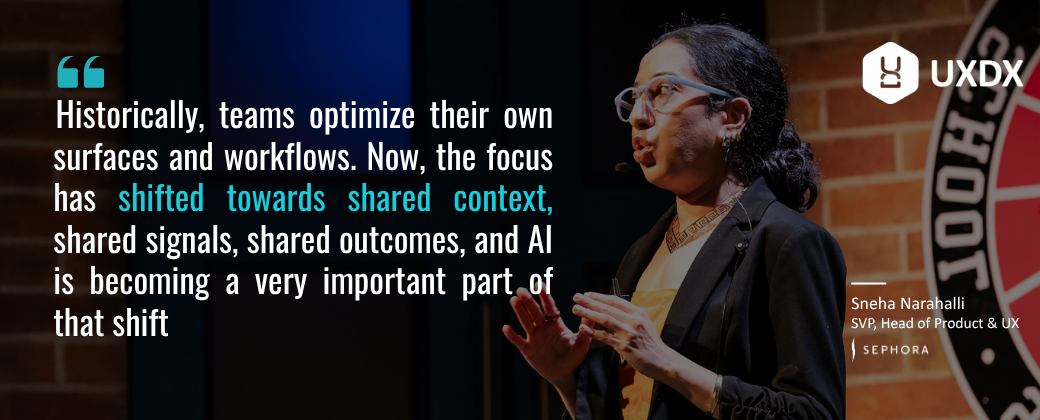
These disciplines can no longer afford to operate in silos, because when context breaks, trust starts to erode.
AI can play a role here by making shared context more accessible. It can help teams surface information that previously lived in someone’s head, reduce fragmentation and coordinate expertise across functions. The goal is not to replace teams, but to help them operate with more shared understanding.
What still isn’t solved
The Q&A pushed on some of the harder questions. One audience member pointed out that this approach seems to rely on identifying a person across sessions and touchpoints, yet some people want to browse without being tracked. Narahalli reframed the problem: “Understanding that a customer also wants to browse without being tracked is a form of intent.” How personalised an experience should be, based on what customers want Sephora to know about them, is itself a signal the system has to understand and respect.
Another question is about product and UX sitting in the same organisation, which has been the case at Sephora for more than five years. The benefit, she said, is a shared understanding of the business problem and real empathy for each other’s roles, which shows up in customer behaviour. The trade-offs are still being navigated, and her answer would have been different a year ago, because the lines between these functions are blurring.
The next era of experience design
Narahalli’s central message was that experience design needs to be redefined for a world where journeys no longer follow predictable paths. The future is not about designing static flows and hoping customers stay inside them. It is about building intent-driven systems that respond to real-time context and help customers make decisions more easily.
For Sephora, that means making beauty feel less overwhelming, more assistive and more connected across every touchpoint. It means recognising that customers want to feel understood and heard. It means designing systems that hide operational complexity while making the experience feel simple, relevant and human.
The brands that win will not necessarily be the ones with the most channels. They will be the ones that make exploding channels feel effortless. In a fragmented world, simplicity becomes the strategy.
Want to watch the full talk?
You can find the full talk here:
https://uxdx.com/session/simplifying-journeys-across-exploding-channels/
Or explore all the insights in the UXDX USA 2026 Post Show Report:
https://uxdx.com/post-show-report

Rory Madden
FounderUXDX
I hate "It depends"! Organisations are complex but I believe that if you resort to it depends it means that you haven't explained it properly or you don't understand it. Having run UXDX for over 6 years I am using the knowledge from hundreds of case studies to create the UXDX model - an opinionated, principle-driven model that will help organisations change their ways of working without "It depends".
Get latest articles straight to your inbox
A weekly list of the latest news across Product, UX, Design and Dev.