The Product Trust Gap


“Whether they booked this one time is one thing. Are they ever going to come back is completely another.”
A product can win an A/B test and still lose the customer. In his talk at UXDX EMEA 2026, Sam Bradley, Head of Consumer Product at PayPal, explored the gap between what product teams can measure quickly and what customers feel over time. His message was a timely warning for every team racing to optimise, personalise and automate: conversion may tell you what happened today, but trust tells you whether people will come back tomorrow.
The experiment that won and still failed
Sam opened with his first experiment as a product manager, at Expedia in 2014. On the flights checkout page, the team tested a timer in the top right corner. Changing behaviour that far down the funnel is very hard, and this did it: a strong conversion uplift worth multiple millions of dollars once annualised. The product review celebrated, and the change rolled out.
Then the customer feedback arrived, through site feedback and customer service, which the team had not looked at before deciding. The timer looked like it was holding the flight, much as ticketing sites hold seats for a short time. It wasn’t. After 20 minutes, it simply disappeared and leaving the tab open did nothing. Expedia was only calling global booking systems, and at the time about 4% of bookings saw a price change at the point of purchase. Customers who had trusted the timer and then met a price change were furious.
The test had raised conversion, and it had also created confusion and broken trust. That is the heart of Sam’s argument: conversion is an incomplete story. Teams are good at measuring what happens quickly, such as whether bookings rose or sign-ups went up. Those numbers don’t capture the friction or frustration, and they can’t tell you whether someone will ever come back.
Trust is easy to break and hard to measure
Sam set this inside a wider shift. Drawing on the “cycle of distrust” in Dan Ariely’s Predictably Irrational, he noted that people are not trusting by default.
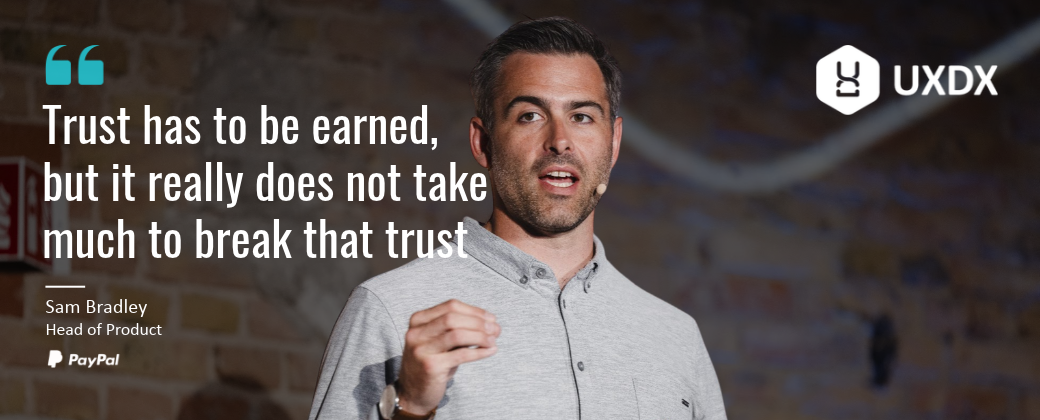
A few bad actors can damage confidence in a whole category. His examples were crypto and holiday rentals, where one company changed the relationship many communities have with how people take holidays, leaving frustration for every other company in the space.
The data points the same way. This year’s Edelman Trust Barometer says 70% of people essentially don’t trust people like them. Germany ranks second to last for trust in international companies, which Sam noted while standing in Germany representing an American company. In the US, trust in big business has been eroding for 25 years and reached an all-time low in data that is two years old. For product teams, where you build and for whom shapes what customers assume before they have used a thing.
At product level, one misleading interaction can colour how someone reads everything else a company does: a timer that doesn’t protect them, a bot that blocks access to help, a recommendation that ignores what they asked for. These cracks are harder to measure than conversion.
Reviews used to be a trust shortcut
Reviews were long the favourite trust signal. Sam, a self-described “review skeptic” who worked on reviews at Expedia, put one stat in almost every user story from 2014: 88% of people trusted online reviews as much as a personal recommendation. Over the last five years, that has flipped, and fewer than half now do. He points to articles about people paying for reviews and a growing scepticism about the whole signal.
Reviews exist to answer one question: will this experience match my expectations? So people look for someone like them, such as a traveller with a small child, and want to control that level of detail with filters and sorting.
AI summaries complicate this. Sam showed a summary for a famous London hotel with nearly 8,000 reviews on a travel site, and it was relentlessly positive and told him nothing useful. In another example, an AI assistant summarised a café’s reviews as excellent sandwiches and friendly staff, then added that other reviews called the staff unprofessional and the food tasteless. His worry was that sentiment analysis may over-anchor on the positive because it is there to sell.
The product question is whether AI makes a trust signal stronger, or just makes the interface cleaner.
A framework for understanding trust
At Expedia, Sam worked with a researcher to measure trust alongside conversion, starting with the drivers of trust, whatever the product. At one end are the basics: is it secure, and is it reliable? Beyond that are connection and benevolence: does it feel like a human is involved, and does the company look out for me? His colleague Sarah defined trust as “the willingness to rely on others in the face of risk,” which is why the bar varies. It’s low for buying a sofa and much higher on an unfamiliar site.
The framework also tracks detractors. At the mild end, an experience feels transactional, with no person involved. Further up are bad intent and unreliability, and at the extreme your information is stolen. In the US, breach notices offering two years of free security tracking are so routine that people are numb to them, but customers with alternatives still stop returning.
PayPal and the trust of protection
PayPal sits at the secure-and-reliable end, and its thesis over 25 years has been trust. Sam’s example is a dodgy-looking site selling a gigantic skeleton, because he has a five-year-old. He feels fine paying because PayPal has his back, and his details go to PayPal, not to a site he has never used.
That trust now has to carry PayPal into rewards, crypto, credit and buy now, pay later, without breaking security or reliability. It also means giving customers control over how their information is used, including easier access in the app to opt out.
Stitch Fix and the trust of being understood
Stitch Fix sits at the other end: benevolence and connection. When Sam worked there, the company combined a data model with a human stylist who sent clothes to your home. Customers kept what they liked, returned the rest and paid only for what they kept. The core idea was “someone did this for me”.
The tension was that the data models were actually better at selecting clothes than the stylists, so increasingly the models picked the items. When it went right, the stylist got the credit. When it went wrong, customers blamed that human connection. They wondered how the stylist could ignore what they had written. “No jeans, please” was a real example, and at the time the model could not read free text, so someone might receive a preview of ten items with six or seven pairs of jeans. Jeans sell well.
Then came the gray sweater problem. Between roughly the fourth and seventh box, the model kept recommending the same thing, a gray sweater, because it’s a wardrobe staple, not expensive and very likely to be kept. Customers received similar, bland boxes and churned around months five to seven, still blaming the stylist. The team tried suggesting different things, like yellows, ignoring the engine, but that wasn’t optimised and sometimes drove churn in tests.
The model was doing what it was designed to do, which was to maximise the chance a customer would keep an item. The customer experienced it as not being listened to. A system can optimise for revenue or engagement while quietly eroding the feeling of being known and respected.
When things go wrong, trust can still grow
Stitch Fix had one thing in its favour: an excellent local, engaged customer service team that would almost always make it right. Sam has seen this in several companies. A perfect transaction, where nothing goes wrong, is fairly transactional. When something goes wrong, he says, it is “actually an incredible trust-building moment,” depending on how the team handles it. “People are very, very willing to give people the benefit of the doubt if they can be made whole.”
That raises an uncomfortable question for the AI era: how much of your customer service is still human? Sam described having to play a game with a bot to reach a person, and warned that customers increasingly can’t control what they see when they have a problem.
AI raises the stakes
Many teams are under pressure to add AI everywhere, but Sam reminded the room that people in tech are early adopters and most customers aren’t. He wondered whether the four generations who might use a product, from Gen Z to baby boomers, would agree on what AI’s role should be or how much of their data should tailor an experience. His own answer was transparency: disclosure about what is built into the product, and control over data and experiences.
What still isn’t solved
Sam was open about the limits of what he could offer, and the Q&A pushed on several.
Measuring trust. “This is still a very inexact science,” he said. His teams rely on consistent quantitative surveys and long-term studies that ask about friction and whether people would use the product again, then track drivers and detractors. It’s case by case.
Long-term effects versus speed. Asked how to lobby for longer A/B tests, Sam recalled a CFO telling him that if he believed everything a product manager said, none of them would ever have to work again. A test is a snapshot, but teams extrapolate it forever. He said the argument came up when his team launched a reviews product in the UK, and they’ve started using holdback groups at the feature level, where customers can still complete the task and no value is withheld. Over time that separates noise from real benefit.
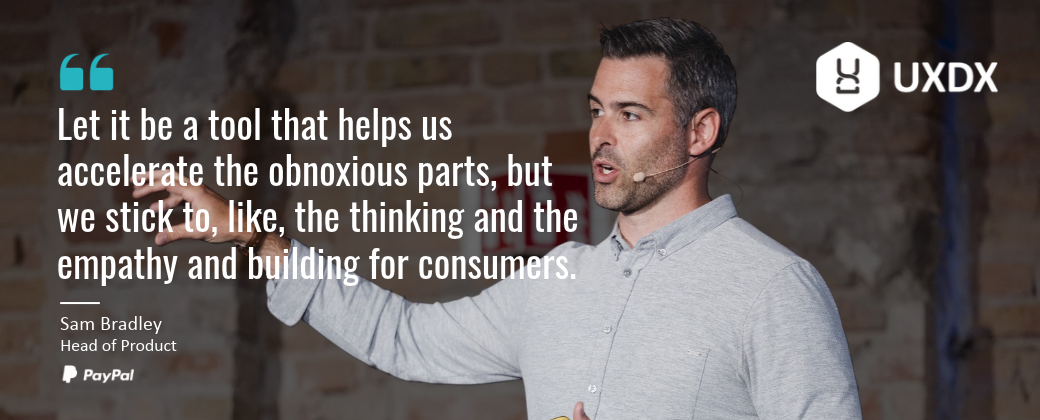
Trust versus AI efficiency. He admitted he wished he had a better answer, and fell back on storytelling: describe the pain customers go through, because the job is to “go make them feel the pain” and build empathy for fixing it, not just for going faster with AI.
Regaining trust. It depends on the person and the product. If switching is easy, customers leave. If they’ve invested heavily in you, they’re more willing to stay if the company acknowledges the problem and works to make it right.
Pressure to use AI everywhere. Sam is “massively skeptical” that machines alone can do the work, since most of it happens in the imperfect margins.
Trust is built through every interaction
Trust isn’t a brand layer placed on top of a product. It is built in the urgency message at checkout, the review summary, the recommendation, the support flow and the recovery path when something goes wrong. A short-term lift can hide long-term damage. A feature can increase bookings and still make people feel misled, and a model can improve immediate revenue and still make customers feel ignored.
In a world where trust in institutions, businesses and online signals is already fragile, product teams cannot afford to treat trust as a soft metric.
The question is not just whether customers convert today. It is whether they believe enough in the experience to return tomorrow.
Want to watch the full talk?
You can find the full talk here:
https://uxdx.com/session/the-product-trust-gap/
Or explore all the insights in the UXDX EMEA 2026 Post Show Report:
https://uxdx.com/post-show-report/

Rory Madden
FounderUXDX
I hate "It depends"! Organisations are complex but I believe that if you resort to it depends it means that you haven't explained it properly or you don't understand it. Having run UXDX for over 6 years I am using the knowledge from hundreds of case studies to create the UXDX model - an opinionated, principle-driven model that will help organisations change their ways of working without "It depends".
Get latest articles straight to your inbox
A weekly list of the latest news across Product, UX, Design and Dev.