Jim Morris
Jim Morris — Founder at Flywheel Product Group. Talks and sessions delivered at UXDX.

Founder

Jim coaches Product leaders and teams in early stage startups, tech companies and Fortune 100 corporations. He is a Silicon Valley veteran having sold a company and gone IPO along with some false starts.
He graduated from Stanford University with a BS in Computer Science and currently lectures in Product Management at the University of California at Berkeley.
Past talks
9 talks · 4 eventsClosing Remarks by Our Host
Jim brings the day together, reflecting on the biggest ideas, tensions and practical lessons from across the programme before we continue the conversation over drinks.
Opening Remarks from Our Host
Jim Morris opens UXDX San Francisco and sets the scene for the day ahead. He'll connect the themes running across the programme, from how AI is changing individual product roles to how teams build, make decisions and organize around the work. Throughout the day, Jim will guide us between sessions, pull out the connections and help turn individual talks into one broader conversation about what AI-native product development actually looks like in practice.
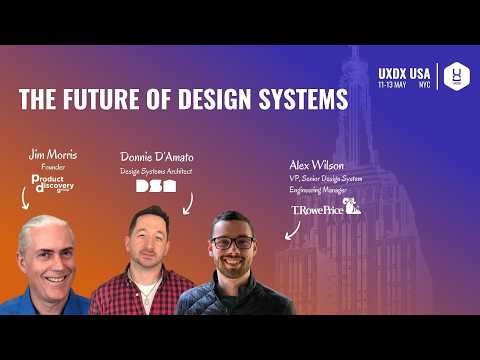
The Future of Design Systems
As AI starts generating more of the interface layer, design systems are no longer just component libraries. They are becoming the rules, constraints, and infrastructure behind dynamic experiences. In this candid discussion moderated by Jim Morris, Donnie D’Amato and Alexander Wilson debate what the next generation of design systems looks like, where they disagree, and what that means for the teams building them.


AI Prototyping for Non-Engineers: Demo + Hackathon
In this session, you’ll become an AI-Enhanced Product Creator. We'll start with how Product Creators have moved beyond basic prompting into higher-leverage activities like tooling, agents and prototyping. Then, we'll go deep into AI prototyping with a hands-on AI Hackathon. Attendees will learn how non-engineers can quickly turn ideas into interactive experiences with an intro to vibe coding, a live demo and then a hands-on hackathon. Each attendee will pick an idea (or bring their own), craft a strong prompt, “code” an interactive prototype (optionally wiring in real APIs), and share prototypes and learnings with the group. Key Topics: - The AI-Enhanced Product Creator. Learn the four personas of AI Product Creators. - AI Techniques for Product Creators. Progress from prompting to higher level AI activities such as tooling, agents, prototyping and coding. - Intro to AI Prototyping/Vibe Coding. Learn how non-engineers with vibe coding tools can quickly manifest ideas into interactive experiences and test with customers faster. Includes a live demo creating a vibe-coded app. - AI Hackathon: Creating Prototypes with Vibe Prototyping Tools. Bring an idea or pick an idea, develop a prompt, and “code” an interactive prototype. Add real APIs for more realistic interactivity. Cross-pollinate progress by sharing prototypes with the group. All in one session. \Note: We will provide credits for a popular vibe coding platform you can use during the session.
AI Prototyping for Non-Engineers: Demo + Hackathon
In this session, you’ll become an AI-Enhanced Product Creator. We'll start with how Product Creators have moved beyond basic prompting into higher-leverage activities like tooling, agents and prototyping. Then, we'll go deep into AI prototyping with a hands-on AI Hackathon. Attendees will learn how non-engineers can quickly turn ideas into interactive experiences with an intro to vibe coding, a live demo and then a hands-on hackathon. Each attendee will pick an idea (or bring their own), craft a strong prompt, “code” an interactive prototype (optionally wiring in real APIs), and share prototypes and learnings with the group. Key Topics: - The AI-Enhanced Product Creator. Learn the four personas of AI Product Creators. - AI Techniques for Product Creators. Progress from prompting to higher level AI activities such as tooling, agents, prototyping and coding. - Intro to AI Prototyping/Vibe Coding. Learn how non-engineers with vibe coding tools can quickly manifest ideas into interactive experiences and test with customers faster. Includes a live demo creating a vibe-coded app. - AI Hackathon: Creating Prototypes with Vibe Prototyping Tools. Bring an idea or pick an idea, develop a prompt, and “code” an interactive prototype. Add real APIs for more realistic interactivity. Cross-pollinate progress by sharing prototypes with the group. All in one session. \Note: We will provide credits for a popular vibe coding platform you can use during the session.

Key Strategies to Win Executive Backing on UX to Ignite Design-Led Business Growth
The panel explores the significant challenges that UX and product professionals face, particularly in securing executive buy-in for user research and what non-UX executives are looking to see. It delves into the importance of aligning UX strategies with business objectives, demonstrating the tangible impact of user experience on key performance indicators, and leveraging design-driven growth for competitive advantage. Each person shares their journey and thinking in building a robust UX research operation within a large corporation, emphasizing the critical role of data in demonstrating the business value of UX efforts. The discussion includes practical advice on measuring and presenting UX outcomes to align with executive priorities, the importance of continuous iteration, data-driven design decisions, and integrating UX research throughout the product development lifecycle. Whether you're a UX professional seeking to elevate your impact across the org, or a product or business leader aiming to harness the power of design, this panel offers essential insights for achieving alignment and driving significant business outcomes.



Design to Learn: Build Prototypes that Get Better Feedback
Has your Product team created a “pixel perfect” design before even talking to users? Does your team fall in love with ideas too quickly? Find out how to use a Design to Learn approach to create “realistic enough” experiences that are meant to learn from users, not persuade them. Build better prototypes and get your ideas in front of customers faster. As you design and validate ideas using the Design to Learn approach, you’ll assemble a world-changing user experience one success at a time. Key Takeaways: - Most features fail to deliver the expected value - how can we minimise this risk? - Change a design culture from perfection to speed - Learn to talk to users sooner in the design process - Focus on the four essential components of a prototype experiment - Stimulate innovation by testing a variety of solutions (take risk!) - Conduct shorter interviews that are quicker to analyze and yield better feedback
Creating Success Metrics That Align Teams to Company Goals
Companies set goals. Product teams deliver features. But they aren't connected. Consistent delivery isn't enough to guarantee company success. Learn to connect the dots between a company's goals and the everyday work of individual teams. In this workshop, you will break down large company goals into actionable team sub-goals. As teams work towards these sub-goals, their individual successes should connect to achieving the company's success. Attendees will learn to create leading indicator metrics that give teams earlier awareness than the more common lagging indicators. You will learn how team level metrics can spot problems, find emerging trends, and prioritize everyday work. Well-written metrics that connect to company goals can guide team decisions, identify root causes of problems and surface investment opportunities. This workshop will be broken down into exercises, and serves to connect company goals to the team level by breaking them down into levels of connected sub-goals (KPI Pyramid) and then direct the work of the team by having them select an important opportunity and success metric (Opportunity Assessment). You’ll walk away with a better understanding of: - Why tracking agile metrics is not enough - Breaking down company goals until they are actionable by individual teams - Comparing and contrasting leading and lagging indicators - Understanding how metrics spot problems, find emerging trends, and prioritize everyday work
Designing Experiments
Every idea relies on multiple assumptions. But testing assumptions isn't always easy. How do you come up with the quickest and cheapest experiments that you can run to validate your assumptions? Join this forum to talk all things guerilla testing, interviewing techniques, validation approaches and more.