From Board AI Pressure to Shipped Product Value


AI has made it easier than ever to build something. That is both its promise and its trap. In her forum at UXDX USA 2026, Cristina Fuser, VP of Product at BuzzFeed, argued that the real challenge is no longer whether teams can prototype, experiment or ship faster. It is whether they can stay disciplined enough to ask the question AI rarely asks for them: why would anyone care?
The pressure to have an AI story
There is a particular kind of pressure that now sits inside most leadership teams. It comes from boards, investors, CEOs, market narratives, hiring conversations and the general fear of being left behind. The question is rarely subtle: what is your AI strategy?
For product teams, that pressure can quickly become a mandate to move. Integrate AI, add AI, build something with AI. Show that the company understands the shift and has a credible story about how it will respond. Cristina pointed out that every company now needs a convincing narrative around AI. Without one, something feels off. It affects confidence, recruitment, investor perception and the sense that the business is prepared for a major technological change.
But Cristina's talk was not another call to move faster for the sake of it. Her central warning was almost the opposite. The hardest part is not finding places to use AI. Look across any product, content, workflow or operational problem and there will be plenty of places where AI could be inserted. The more difficult question is whether it should be.
The question AI does not ask
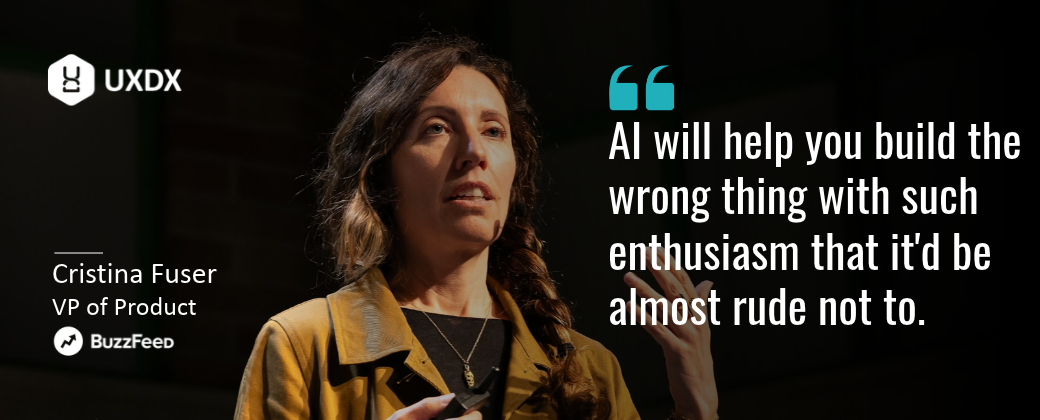
That distinction matters because AI is an unusually persuasive building partner. It will help you generate ideas, write code, create prototypes, test concepts and keep moving. It is relentless, tireless and extremely encouraging.
What it does not naturally do is stop and ask the basic product question that still matters most: why?
Why invest the team's time and the company's money in this idea? What problem is it solving? Who is it for? And, most importantly, who will ever care about it?
These are old questions, but AI makes them easier to skip. When a prototype took weeks, teams had more natural friction in the process. There was time to question the idea, test the problem, discuss the user and evaluate whether the work was worth doing at all. Now, a convincing prototype can appear quickly enough to create its own momentum. Once something looks real, it becomes harder to stop. People start debating how to improve it rather than whether it should exist.
When good ideas miss the user
Cristina's examples from BuzzFeed made that tension feel very real. One of the most memorable was Botatouille, an AI chatbot added to Tasty, BuzzFeed's cooking app. On paper, the idea made perfect sense. Users could ask cooking questions, convert measurements, request substitutions or adapt recipes to different dietary needs. At a moment when everyone was experimenting with chatbots, it felt like an obvious fit.
In practice, it did not work. People came to Tasty to browse recipes, and that browsing experience was part of the pleasure. Asking users to suddenly start a conversation with a robot created effort where there had previously been ease. Instead of helping people flow through recipe discovery, it interrupted them. Some users also asked questions that had nothing to do with cooking, which underlined the gap between the intended use case and actual behaviour.
The point was not that chatbots have no place in product experiences. It was that the team had not involved users before building. Internally, the idea seemed logical. In the real context of the app, it created friction.
A second example came from the newsroom. BuzzFeed built a tool called Time Hop, designed to help writers identify story opportunities based on historical performance. If an author had written strong pieces around a particular theme every April, the tool could surface timely ideas when that pattern came around again. It sounded useful, and the team expected writers to love it.
They never used it.
One of the reasons was almost painfully simple: it was not integrated into the CMS. Writers had to leave their normal workflow, remember where the tool was and make a separate effort to use it. That extra step was enough to prevent adoption. The team had been so excited to surprise the newsroom that it never asked writers what they needed. And as Cristina pointed out, involving people is not only about asking them. It is about making them feel responsible for the outcome, so that they want to use what gets built.
The third example was the most ambitious: a social media product built around AI. On paper, it sounded exciting. In reality, many people did not care, and some reacted badly to anything labelled AI at all.
These stories are valuable because they are not dramatic failures. They are the kind of plausible, well-intentioned experiments that happen in every organisation. The ideas made sense. The teams were capable. The technology worked well enough. What was missing was the discipline to stay close to the user, the workflow and the real reason the product should exist. None of it was new, as Cristina admitted: "When there's a new tool, you forget everything you've always known… and then you have to relearn the lessons of the last decade, all over again."
Speed is not the same as progress
That is where Cristina's argument becomes especially useful for product leaders. AI does not remove the need for product thinking. It makes product thinking more important. If teams can now build faster than ever, they need sharper judgement about what deserves to be built in the first place.
For Cristina, the biggest opportunity with AI is not simply speed. BuzzFeed has been able to ship faster than ever over the last nine months, but speed alone does not prove anything. "You're just moving faster, but in which direction?" The more important question is what the team is learning faster, and how that learning changes what they do next.
Prototypes as decision tools
This reframes the value of AI-assisted prototyping. A prototype is not just a faster version of a wireframe, and it is not a shortcut that makes designers unnecessary. Used well, it becomes a tool for decision-making. Product managers who might once have described an idea verbally on a call can now bring something experiential into the room. Instead of saying, "the user clicks here, then this happens," they can show the flow, test the logic and discover what does or does not work.
That changes the quality of alignment. Designers, engineers and executives are no longer reacting to an abstract description. They can experience the idea, challenge it and make decisions with more confidence. Some PMs at BuzzFeed now use AI-assisted prototyping almost as a brainstorming partner. They begin with a vision, but once they see it working, they realise where the concept breaks down or where it could become stronger.
One BuzzFeed team used this approach to build Quiz Party, an app for taking quizzes with friends synchronously and asynchronously. They moved from an early prototype to a TestFlight app in a month, something that would previously have been very difficult in app development. In another case, a feature idea inside a larger AI-driven social product seemed strong enough to stand alone. Before, that kind of detour would have been dismissed as a distraction. With AI, the team built a prototype in a week and could see that the idea was stronger as a standalone app.
This is where AI starts to create real product value. Not when it encourages teams to chase every idea, but when it lowers the cost of learning enough to make better decisions.
Measure before the feedback arrives
However, faster learning only works if teams know how they will interpret the results. Cristina was clear that measurement needs to be agreed upfront. Before a team launches an experiment, they should know what success looks like, what threshold would justify further investment, what signal would lead them to kill the idea and what would make it worth scaling.
Without that clarity, feedback becomes political. Everyone can arrive at the meeting with a persuasive AI-generated argument for why the team should continue, stop or pivot. The way to cut through that is to agree on the numbers in advance. "You just have to look at the numbers, and you've shaken hands on those numbers in the beginning."
That also means taking the time to connect new products to a proper analytics system. AI can set up tracking for you, but Cristina found that it can make the data harder to trust.
BuzzFeed applied this thinking when editorial team members were allowed to publish interactive experiences directly to the site. That was a major shift, because it gave creative people outside traditional engineering workflows the power to ship. The only way to make that safe was to establish a graduation system. If an experience reached a certain retention threshold, it could move into the permanent games platform. If users rejected it, and they were very honest when they did, the team could remove it quickly.
Changing the team around the technology
That kind of structure matters because AI changes not only what teams can build, but how they need to work. BuzzFeed experimented with one-month challenges and very small teams, sometimes as small as three people. The one-month timeline was arbitrary, but useful. It created a boundary around risk. Losing a month on a weak idea was acceptable. Losing a year was not.
Small teams also changed the rhythm of decision-making. With fewer people involved, there was less time lost to alignment, meetings and handoffs. Roles became more fluid. Designers sometimes acted like product managers. Product people shipped code. Developers who were initially sceptical of AI had to reconsider when they saw colleagues moving faster. The goal was not to remove expertise, but to make the team more flexible around the work.
Feedback becomes the process
Even the meaning of a daily stand-up changed. In a traditional process, teams often report which ticket they closed yesterday and which one they will work on today. In a faster AI-enabled environment, that is not the most useful conversation. If feedback is coming in quickly and changes are cheaper to make, the daily question becomes: what should we change based on what we learned?
That is a profound shift. Feedback is no longer a disruption to delivery. It becomes the engine of delivery. And if a team still treats feedback as a disruption, Cristina suggested, that is a clear sign its process has not yet changed to make the most of the technology.
Start where judgement is strongest
Cristina closed with several practical lessons that were deliberately simple. Commit a couple of hours a week to learning how to use AI properly, rather than giving up and reverting to old habits when the first attempt does not work.
Start with personal projects, where the stakes are lower and the motivation is stronger. One BuzzFeed team member coaches his children's school running team. He fed the runners' performance data into a simulation, asked AI for training plans that would raise their chances of winning and watched the team win its next race. He then brought the same idea to work: what if every writer opened the CMS to suggestions based on their own performance data?
Do not cling too tightly to old processes just because they are familiar. Focus on the input and the output you want, and let AI figure out more of what happens in between. And begin with work you already understand deeply, because it is much easier to judge AI's output when you know what good looks like.
The one thing still worth writing down
In the Q&A, Cristina was asked whether PRDs still exist at BuzzFeed. They do, but they are much shorter. When a prototype is available, it becomes the core of the spec. Nobody needs paragraphs describing edge cases that people can simply click through. The document is now mostly about coordination: milestones, owners and how the work will ship.
But some things still have to be written down before anything is built. "The number one thing that we still have to write down is what is the goal, how we're going to measure it, who's going to give us the feedback."
That is the question of why, turned into something a team can act on. It is also the thing that slips most easily when building feels effortless. When Cristina polled the audience on the biggest bottleneck to integrating AI successfully, many pointed to process and changing habits. She was surprised more people did not choose forgetting to ask why. In her experience, it is the biggest issue of all.
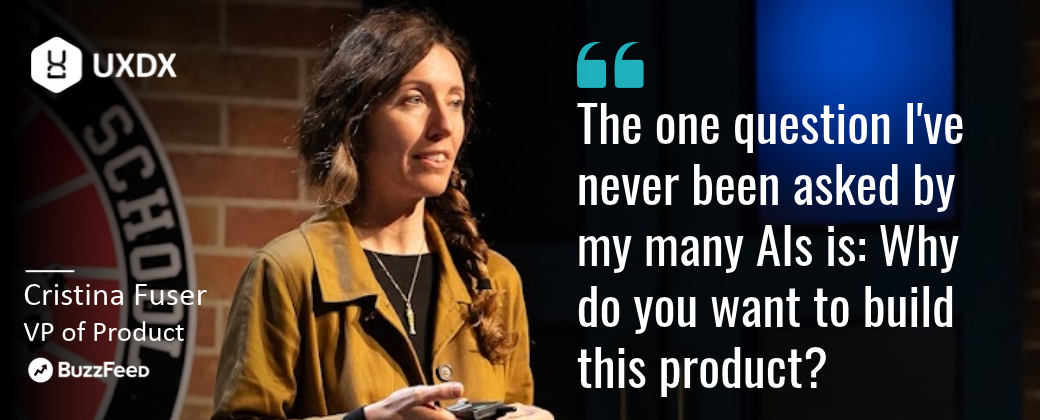
AI can now produce the prototype, the code and even the argument for keeping something alive. What it cannot produce is the agreement, made before the building starts, on who the product is for, what success looks like and who will tell the team the truth.
You can find Cristina's full talk here: https://uxdx.com/session/from-board-ai-pressure-to-shipped-product-value/
Or explore all the insights in the UXDX USA 2026 Post Show Report: https://uxdx.com/post-show-report

Rory Madden
FounderUXDX
I hate "It depends"! Organisations are complex but I believe that if you resort to it depends it means that you haven't explained it properly or you don't understand it. Having run UXDX for over 6 years I am using the knowledge from hundreds of case studies to create the UXDX model - an opinionated, principle-driven model that will help organisations change their ways of working without "It depends".
Get latest articles straight to your inbox
A weekly list of the latest news across Product, UX, Design and Dev.