
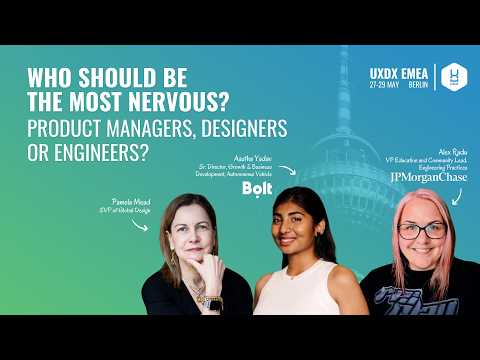
Senior strategy leader with top-tier consulting background from Bain & Co., Aastha has been heading global product strategy & planning at Bolt for 6 years.
She leads product / model discovery, evolution and optimization initiatives across 50 countries. Bolt operates in over 600 cities with at least 1 out of its 5 products, catering to more than 200 million lifetime customers. Drawing on her extensive experience in management consulting, product strategy & operations, Aastha also advises startups on product strategy, growth and expansion.
Upcoming Talks
28 May 2026
AI isn’t coming. It’s already reshaping how products are built.
It writes code, generates designs, synthesises research, and compresses workflows that used to span teams and weeks into minutes. It removes friction—and with it, many of the traditional boundaries between roles.
But it doesn’t just accelerate output. It exposes it.
When execution becomes abundant, the bottleneck shifts.
From building → to deciding what’s worth building.
From producing artefacts → to exercising judgment.
From process → to understanding.
This is not the end of product, design, or engineering.
But it is the end of operating at the surface.
In this session, we’ll examine what actually changes when AI becomes embedded in the way we work—not from a hype perspective, but from the realities teams are already facing.
We’ll explore how roles evolve when tools can do the work, where depth still matters, and what differentiates teams that get better with AI from those that simply move faster.
- Why AI exposes every discipline in product development
- Why both shallow generalists and narrow specialists are increasingly vulnerable
- How team structures shift when handoffs disappear and individuals can execute across domains
- What “depth” really means when output is cheap and instant
- How to rethink generalist vs specialist when AI fills capability gaps but not judgment
- Which skills, mental models, and fundamentals compound, and which decay


